The “Protect Our Games Act” is the Pinnacle of First World Problems

Imaging this situation: You purchased a video game and really enjoy it. You may even invest something in becoming a great player. Then, suddenly, the game’s developer shuts it down. In the past, you could probably play it offline or on private multiplayer sessions, but increasingly, games are cloud-based and require backend infrastructure to run at all.

That can be a huge bummer. A massive one. It’s like many things in digital life. Stuff gets sunset. A lot of people were sad to see AIM die, and there were certainly people who still relied on it. Perhaps you were one of the few who really loved the Metaverse. Now it’s being shut down too. The same happened to a huge number of other services. GeoCities, MSN messenger, Skype and plenty of others are gone.

There is a legitimate question is to whether providers owe their end users some level of continued support, or at least providing some kind of open source or third party option for support of deprecated software and IT infrastructure. There is already a mechanism to enforce this, for those who take it seriously: contractual obligations for ongoing support or graceful sunsetting and be built into agreements, but rarely are.

But where does that leave video games?

As mentioned, this can absolutely happen with video games, but that would seem to be one the least concerning examples. After all, video game developers can’t really be expected to provide the support for old games forever. They are private organizations and they exist for entertainment purposes. They may well find that old game infrastructure operates at a net loss and cannibalizes new game sales. There are also times that a game just is not that successful. Even with a few dedicated fans, many games just fail in the market.

There’s also the issue of video games as a form of artistic expression. If the game developer really has created something in their vision, there’s an argument that they should maintain creative control over its destiny, even choosing to shut it down when it is still popular, the way that Jerry Seinfeld took his show off air before it began to fade.

Well California feels differently, and I have to call this what it is: the most first world problem I have ever seen in my life. Because, while we can go around in circles endlessly, debating whether it’s not fair to the consumer or whether the producer should have greater rights, one thing is undeniable: these are video games.

Continue reading

A Full List of Risks of AI to Society

AI is a big thing, a huge force in the economy and basically the top story in tech since 2022. It promises to have major impacts on society and technology, and it already has. With this, of course, come risks. Every new technology or change in a society has ups and downs. This is no different with AI. With new capability comes the potential for misuse or unexpected failure modes.

This has happened many times when technology was deployed, with great enthusiasm and little concern for risks and controls. The problem with AI, unfortunately, is that discussion of AI risk quickly descends into ridiculous philosophical banter, in which people who have no idea how the technology works try to appoint themselves experts and then dominate with riduclous concerns.

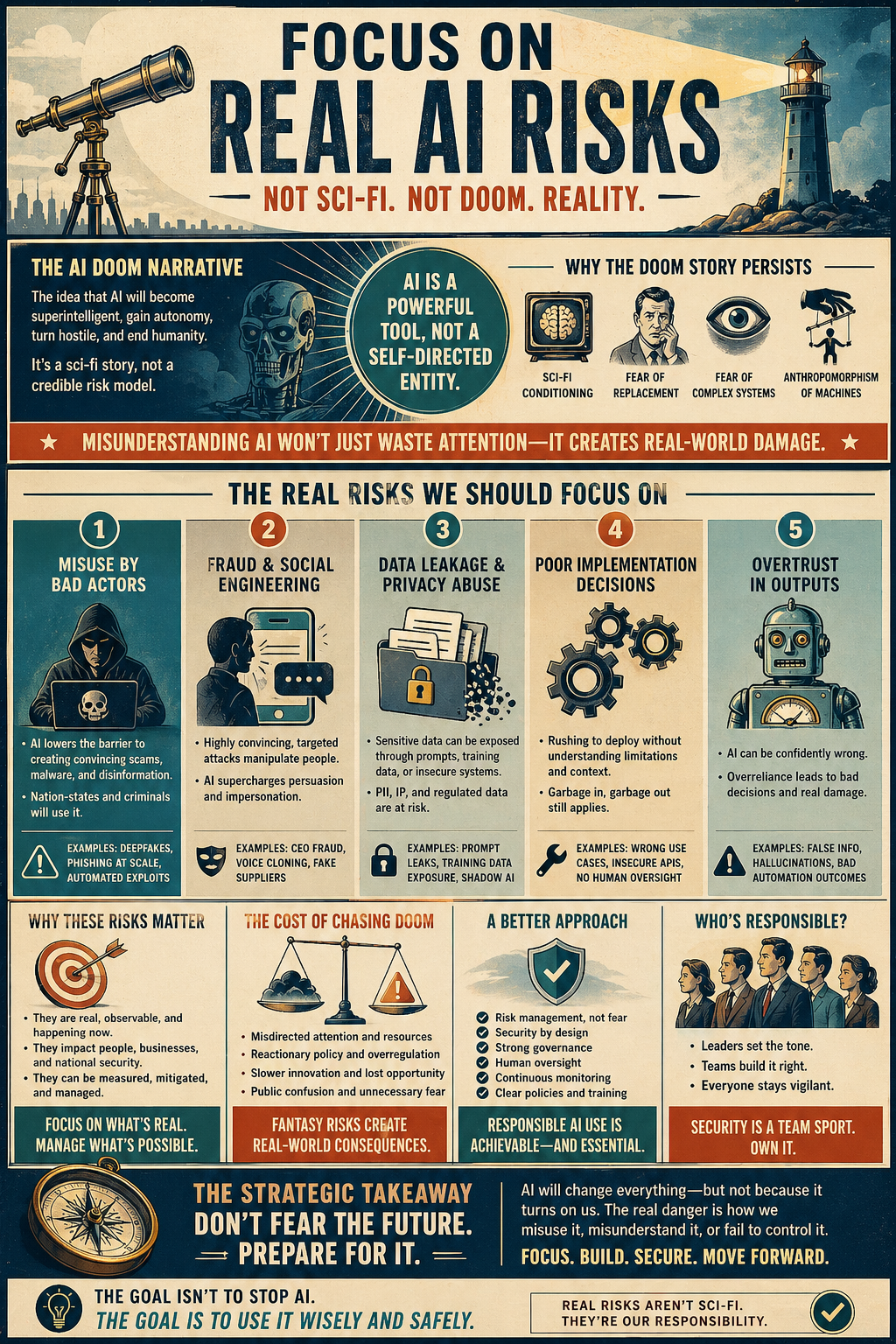
The “AI Risk” and “AI Safety” community are dominated by people who bought into the ramblings of doom grifters with books and Ted talks to sell. This is a problem, because there are real risks and risks that should be considered. Rarely do the adults in the room get to have the conversation. AI has no intentions, it is flawed and imperfect, and the idea of superintelligence is flawed. And yet, the real danger is that this will crowd out discussion of the issues that are legitimate risks.

Here is a comprehensive taxonomy of what the risks are to society of the deployment of AI at scale. This does not include the internal risks to organizations of AI failure. Discussing how models fail is another important area, but it’s a different topic.

I am sure that some will disagree about how severe the risks are and if I am downplaying them. For one thing, I started thinking AI would result in mass unemployment, but after looking at the situation and the model capabilities, I was surprised to find that I found that conclusion is not supported by evidence. This is probably the one area people will disagree with the most.

Continue reading

AGI: Cutting Through The Confusion

AGI, ASI and the extreme confusion of it all

There has recently been a huge amount of confusion over the concept of Artificial General Intelligence, AGI, and exactly what it means, whether it is something that should be expected, and what it means for society.  One thing that is seen frequently is speculation of the “Race to AGI” or questions like “How will we know when we have AGI” or “What if they already have AGI and haven’t told anyone?”

This whole line of reasoning, the way it is framed, and the questions being asked here indicate complete incoherence about what AGI or Artificial General Intelligence is, or at least what it is supposed to be. If that is not bad enough we now are being told that AI is close to “super intelligence” or “ASI.” This is an entirely fictional idea, and nobody can even agree as to what it is, other than it might be scary.

The Basic Idea of AGI

The concept of artificial intelligence in the form of a fictionalized “thinking machine” goes back centuries.  The modern concept of computer systems that simulate intelligent behavior dates to the 1950’s.  As systems dubbed AI were developed, it was clear that they were relatively narrow and bounded in what they could do.  Machine learning and cognitive simulations could optimize systems and respond to variables, but they lacked the kind of “intelligence” that we think of in a human.

Intuitively, it was always clear that there existed a higher level of “general intelligence” of the type found in humans and other thinking beings.  In the simplest sense, an AI that could be communicated with, like a person and could understand human-like concepts, like situations being subjectively better or worse.  It made perfect sense that the mental model for what general intelligence would look like would be a synthetic human mind.

The terms for Artificial General Intelligence versus Narrow Artificial Intelligence was coined in 2007, but the basic concept goes back much further.  It had been often called “strong AI,” “human-like AI,” “full AI,” or “true AI.”   In fact, this distinction became obvious early in the field of AI, when it was clear that systems that could mimic certain aspects of human intelligence were distinct from the popular nation of a fully digital mind, or anything like human level capabilities across domains.

Continue reading

The Problem of False Expertise in AI

There is something worse than ignorance, and that is false expertise. This happens in all fiends, but it’s worse in fields that are poorly understood and those which are hot and popular in the press. Of course, nothing is hotter than AI and few things are more poorly understood.

There are quite a few people out there calling themselves experts. There are legitimately not that many people out there who understand AI, and even fewer of them are known for public speaking. Yuval Noah Harari is an example of this. He’s an historian and best selling author.

But does that mean he knows AI? No. No, it does noit.

Anthropic and the Pentagon Situation

It was just last week that I posted a brief write-up about the situation with Anthropic and the Department of Defense. At the time, it seemed like the worst thing that might happen to Anthropic was a loss of military contracts, but things have escalated. The Pentagon and the Trump administration have ordered the discontinuation of Anthropic products by government agencies and contractors.

This is highly unusual and an extremely aggressive move. Anthropic has received a groundswell of public support, and OpenAI has been getting a lot of criticism for stepping in and signing a major contract as soon as Anthropic was excluded.

The Morally Bankruptcy of Social Media Influencers

This rant is a bit off topic, but I am really taken by how badly social media influencers have inserted themselves into the tragic disappearance of Nancy Guthrie, Savanah Guthrie’s mother. We don’t know what happened to Nancy and 31 days on, things do not look good. No communications has been verified as coming from the perpetrators and the investigation seems to have little direction.

While I do not know Savannah, I’ve met her several times and she’s always been an extremely kind person, but beyond that, this isn’t just a celebrity story: it’s a tragic story of a family trying to find their mother, who was taken, apparently by malicious persons meaning harm. it’s a nightmare.

But for those who want to appoint themselves web sleuths? For social media influencers? For those who want to be thought of as an expert and have a YouTube channel/blog post/podcast to sell? There’s no limit to the baseless speculation and repeated attacks on the Guthrie family, especially her son in law and persons who are only guilty of being part of his life. These egotistical self-promoting vultures do not seem to see any harm in what they are doing.


Do not upvote, subscribe or even engage with these idiotic and useless videos. That’s what gives them an audience and promotes them via YouTube and social media algorithms.

We Need To Take AI Doomerism Seriously

No, not the actual belief. The idea that AI will become a cartoon supervillain and wipe out humanity is as idiotic as it sounds. The danger is that the belief is getting credibility, is taken seriously and is a dangerous red hearing. The grifter economy of AI doom is a self-serving scam, but the consequences are real.

I personally find AI Doom to be more than a nuisance. Most do not realize this but, when you peel away the curtain, the movement is actually based on a strong cult-like belief and has spawned some extremely disturbing rhetoric. There have been threats against AI labs and ridiculous proposals for legislation to pause or stop AI research. There are all kinds of ridiculous claims being made and they are getting media attention> Almost nobody seems to be aware of the true nature of this ridiculous idea.

Most AI experts have disengaged from the nonsense of AI doom. After all, it’s not like it’s interesting and nobody wants to have to deal with their area of expertise being stepped on by people who don’t know what they’re talking about. However, this is dangerous. Doom movements have grown around other technologies: nano technology, vaccines, genetic engineering, nuclear energy and others. What we know is that these movements, unhinged and unsupported though they may be, do not go away and frequently lead to bad legislation and major problems for industries that do not fight back.

AI doom is an especially prevalent threat and it’s receiving mainstream legitimacy and attention, which should be seen as a major problem in and of itself.

What is AI Doom

AI Doom is the basic idea that there is some kind of unique and existential threat to humanity, based on the idea that AI systems and ML models might become “super intelligent” and therefore impossible to stop from causing harm. This is also predicated on the idea that in addition to intelligence being a scaler, which can be arrived at through increased compute, that the resulting intelligence would somehow achieve autonomy and become either hostile to humans or desire to eliminate humans to gain more resources.

It’s not an entirely new idea. It’s been a trope in science fiction for some time. It is based on a lot of universal fears, like not understanding technology, being replaced, dehumanization and the fact that people have been so conditioned by science fiction to expect such an outcome to be reasonable.

Doom literally refers to an “end of the world” scenario, but there are other doom adjacent beliefs and claims, such as the idea that AI will lead to a permanent dystopian society where employment is impossible and power is consolidated or that AI may enslave humanity.

Importantly, while there are absolutely risks of a variety of types that are associated with AI adoption, the idea of a species-level risk from the technology gaining self-motivation and setting its own goals is not plausible at all.

Continue reading

New Youtube Channel and Focus on AI

Artificial Intelligence has more mysticism than just about any other subject out there. I’ve never seen any subject so poorly understood and so sensationalized. It’s a technology that everyone seems to realize is big, revolutionary and important. But that’s only resulted in a huge amount of mythology.

Few people understand AI from a technical perspective, but just about everyone *thinks* they understand it, because it seems so intuitive. It seems like you can just talk to it and it understands, so the implications are obvious, right?

Right now the world has a deficiency in AI experts who understand the tech, and even fewer are mature risk managers. That’s resulted in a lot of skewing toward sensationalism. Most AI leaders are not even knowledge about the tech and the media rewards a high drama narrative. There are a few ways it skews: one of the most ridiculous messages is AI doomerism, the idea that AI might wipe out humanity. It’s cartoonish but it receives more attention than it should. There are also claims of permanent unemployment. On the other end is AI utopianism. There are also those insisting AI might become conscious or a moral patient. Yes, this is also being taken seriously.

It’s really a subject that attracts all kinds. But few people realize that like any technology, AI and ML have fundamental limits and capabilities. They’re not magic. But the recent AI summit in India would have you think otherwise, with ubiquitous claims of being close to superintelligence.

And so, as one of the few AI technical experts willing to address this problem I have launched a new YouTube Channel and will be focusing primarily on this topic. AI risks, mitigations, technology and truth: AI Sanity, on Youtube.

Where We Really Stand In AI Capabilities

The recent talk of AGI, as if it is some kind of impending certainty, and now talk about “Superintelligence” is really causing a great deal of confusion. The reality is that we are nowhere near the point of human level intelligence in all domains, the idea of artificial super intelligence, is entirely speculative and nowhere near foreseeable capabilities, and you can’t scale past the limits of current AI systems. The truth has been lost in a sea of sensational rhetoric.

The modern public discourse around artificial intelligence began with a fundamental shift in frame of reference. For decades, AI systems were narrow, technical, and largely invisible to the general public. Then, quite suddenly, natural language processing systems emerged with startling fluency. For the first time, people could interact with a machine through conversational language that resembled human dialogue.

This single development reset public intuition overnight.

Instead of being understood as statistical systems operating within defined computational constraints, large language models were immediately interpreted through the lens of science fiction archetypes: conversational minds, digital assistants, synthetic intellects. The resemblance in surface behavior was compelling enough to override the underlying reality of how these systems actually function.

But fluency is not cognition. Simulation of reasoning is not reasoning itself.

Continue reading

The Narrative About AI Triggered Job Loss is Speculative and Irresponsible

We are seeing an increased public narrative about the potential for job losses from AI deployment. These claims receive a great deal of media attention and are rewarded in the social media landscape for being as pessimistic as possible. Mass job loss remains highly speculative and many claims skew to the highly implausible. But this is causing mass harm.

The increasingly popular narrative of inevitable, catastrophic, long-term job loss due to artificial intelligence is not grounded in robust empirical evidence. It is overwhelmingly speculative, framed in worst-case abstractions, and presented to the public with a level of certainty that far exceeds what the data justifies. That alone would be intellectually questionable. But the deeper issue is ethical: the psychological and social harm caused by repeatedly presenting extreme scenarios as near-certainties.

There is a very real human cost to this discourse. People are not reading these forecasts as academic hypotheticals. They are internalizing them as personal futures. Students reconsider career paths. Mid-career professionals experience anxiety and loss of motivation. Workers in already uncertain labor markets feel prematurely obsolete. This is not a trivial side effect. It is a measurable psychological burden placed on millions of people based on projections that remain deeply uncertain and, in many cases, methodologically weak.

Serious economic forecasting requires discipline, historical grounding, and humility about technological diffusion. What we are instead seeing in many public conversations is a pattern of extrapolation from capability demos directly to labor market collapse, skipping entirely over the realities of workflow integration, governance constraints, liability frameworks, organizational inertia, and economic adaptation. That is not analysis. That is narrative acceleration.

Continue reading