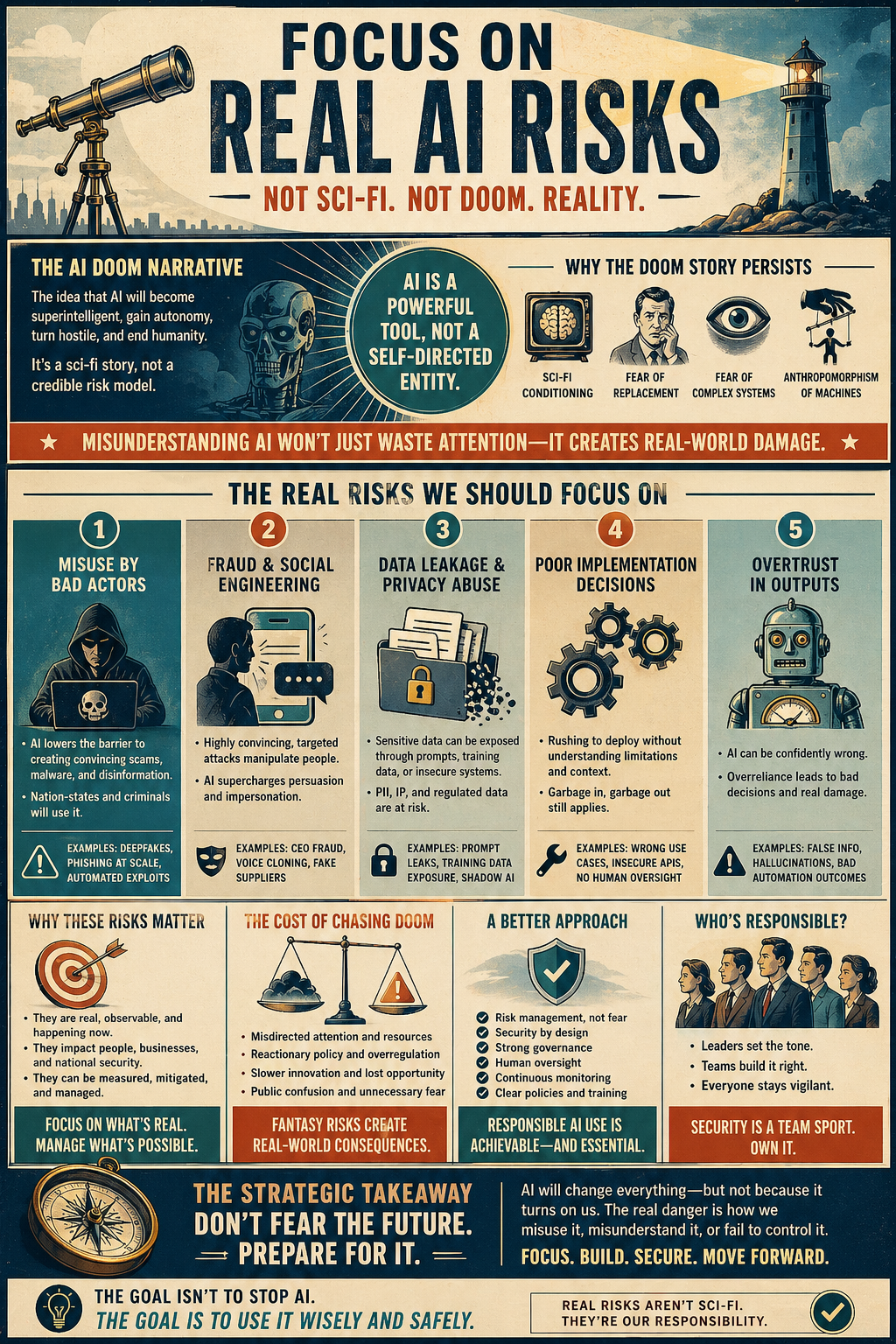
A Full List of Risks of AI to Society

AI is a big thing, a huge force in the economy and basically the top story in tech since 2022. It promises to have major impacts on society and technology, and it already has. With this, of course, come risks. Every new technology or change in a society has ups and downs. This is no different with AI. With new capability comes the potential for misuse or unexpected failure modes.

This has happened many times when technology was deployed, with great enthusiasm and little concern for risks and controls. The problem with AI, unfortunately, is that discussion of AI risk quickly descends into ridiculous philosophical banter, in which people who have no idea how the technology works try to appoint themselves experts and then dominate with riduclous concerns.

The “AI Risk” and “AI Safety” community are dominated by people who bought into the ramblings of doom grifters with books and Ted talks to sell. This is a problem, because there are real risks and risks that should be considered. Rarely do the adults in the room get to have the conversation. AI has no intentions, it is flawed and imperfect, and the idea of superintelligence is flawed. And yet, the real danger is that this will crowd out discussion of the issues that are legitimate risks.

Here is a comprehensive taxonomy of what the risks are to society of the deployment of AI at scale. This does not include the internal risks to organizations of AI failure. Discussing how models fail is another important area, but it’s a different topic.

I am sure that some will disagree about how severe the risks are and if I am downplaying them. For one thing, I started thinking AI would result in mass unemployment, but after looking at the situation and the model capabilities, I was surprised to find that I found that conclusion is not supported by evidence. This is probably the one area people will disagree with the most.

Continue reading

Preview of Another Book Chapter

I have decided to publish a second rough draft of a book chapter. One of my primary reasons is to get the content out as soon as possible, since my motivation is to help with the extreme misinformation being circulated about AI.

The idiotic “doom” movement continues to operate with seeming credibility despite the childish message that superintelligence will take over the world, like some kind of cartoon villain. Unfortunately, refuting this is hard, because adherents have a completely wrong understanding of how the technology works.

It is clear that to resist this lunacy, along with the equally stupid idea that models might be conscious or have feelings, you simply need to know how this actually works. That’s what “Understanding AI” is all about. That’s why I’m writing the book. It’s a decidedly not dumbed down primer on AI. It explains the theory, early evolution, why things are done as they are, neural networks, deep learning, natural language processing and generative AI.

This unapologetic adult and broad primer will help make anyone immune to the extreme cultish nonsense that has surround the subject. It does not go into depth more than it needs to, but it assures all relevant concepts are covered in a computer way that does not insult the readers intelligence.

This is not the second chapter of the book, but rather the 7th. It is, of course, subject to change, as it is a draft. But, putting it out there, if nothing else, holds my feet to the fire, to get it done. I’m sure it will receive at least three major revisions, but so far I have not seen such a comprehensive account of the dawn of generative AI from anyone inside the industry.

Continue reading

AGI: Cutting Through The Confusion

AGI, ASI and the extreme confusion of it all

There has recently been a huge amount of confusion over the concept of Artificial General Intelligence, AGI, and exactly what it means, whether it is something that should be expected, and what it means for society.  One thing that is seen frequently is speculation of the “Race to AGI” or questions like “How will we know when we have AGI” or “What if they already have AGI and haven’t told anyone?”

This whole line of reasoning, the way it is framed, and the questions being asked here indicate complete incoherence about what AGI or Artificial General Intelligence is, or at least what it is supposed to be. If that is not bad enough we now are being told that AI is close to “super intelligence” or “ASI.” This is an entirely fictional idea, and nobody can even agree as to what it is, other than it might be scary.

The Basic Idea of AGI

The concept of artificial intelligence in the form of a fictionalized “thinking machine” goes back centuries.  The modern concept of computer systems that simulate intelligent behavior dates to the 1950’s.  As systems dubbed AI were developed, it was clear that they were relatively narrow and bounded in what they could do.  Machine learning and cognitive simulations could optimize systems and respond to variables, but they lacked the kind of “intelligence” that we think of in a human.

Intuitively, it was always clear that there existed a higher level of “general intelligence” of the type found in humans and other thinking beings.  In the simplest sense, an AI that could be communicated with, like a person and could understand human-like concepts, like situations being subjectively better or worse.  It made perfect sense that the mental model for what general intelligence would look like would be a synthetic human mind.

The terms for Artificial General Intelligence versus Narrow Artificial Intelligence was coined in 2007, but the basic concept goes back much further.  It had been often called “strong AI,” “human-like AI,” “full AI,” or “true AI.”   In fact, this distinction became obvious early in the field of AI, when it was clear that systems that could mimic certain aspects of human intelligence were distinct from the popular nation of a fully digital mind, or anything like human level capabilities across domains.

Continue reading

First Draft of First Chapter of My Book “Understanding AI”

So I have decided to write a book. Crazy, perhaps. It is something I have wanted to do for years and faced many false starts. I think a lot of people have been through that. It’s not easy, but I knew that. It’s actually harder than you’d ever imagine, at least for me, but then again, this is the first time I have truly committed to the pursuit.

The reason I choose to write this is that AI is the most poorly understood topic I have ever seen, and has been wrapped in mythology. This is especially true with “AI Doom.” The problem with these beliefs is that they are difficult to refute without teaching a full lesson on AI. So, I guess that’s what I’m going to have to do! I’m not complaining, however. The fact is, there is really no in-depth guide for smart people who want to truly understand the concept of artificial intelligence.

I want to be clear that this is a first draft of the first chapter. It will be revised, probably several times. It currently lacks citations, but those will be added. Citations will be minimal because this is not a scholarly work, but should still have basic source credibility. Additionally, this chapter contains assertions which some might call bold or unsupported. There’s a reason for that and the reason is that this is just the first chapter.

Subsequent chapters will explore the history of AI as a concept and technology, including the pre-history and how formal logic rules, early computers and language itself set the stage for a new form of data processing, which we call artificial intelligence. It goes on to explain the theory of deep learning and neural networks, why this approach won out, and will take readers all the way to understanding natural language processing.

It’s not designed to be easy or dumbed down. However, it is intended to be fully complete for any lay person to fully understand why AI is the way it is, how we got her and where it is likely to go next. It is also not entirely technical. It features historic concept, public perception, regulatory issues and economic realities.

I also want to add that there are a number of people out there who are writing hot takes on AI that are completely uninformed, and this is intended to be the opposite of that. It’s down to earth, skeptical and presents the truth about artificial intelligence.

The working title is “Understanding AI.”


AND HERE IT IS!

Continue reading

The Problem of False Expertise in AI

There is something worse than ignorance, and that is false expertise. This happens in all fiends, but it’s worse in fields that are poorly understood and those which are hot and popular in the press. Of course, nothing is hotter than AI and few things are more poorly understood.

There are quite a few people out there calling themselves experts. There are legitimately not that many people out there who understand AI, and even fewer of them are known for public speaking. Yuval Noah Harari is an example of this. He’s an historian and best selling author.

But does that mean he knows AI? No. No, it does noit.

Should Chatbots Refuse to Give High Risk Advice?

Chatbots are becoming increasingly popular. ChatGPT, for example, has nearly a billion weekly users. These LLM based services are used for all kinds of things, including many things their initial developers never dreamed of: planning, brainstorming, writing, translation, companionship, functional play, humor, studying, reformatting text, creating code. People also ask chatbots for all kinds of advice and facts. Chatbots have become the goto answer engines for questions ranging from “What is the capital of Chad?” to “How long should I boil a lobster for?”

However, there is a problem with LLMs and that is that they “hallucinate.” The term hallucination is a bit of a misnomer, because what is actually happening has less to do with figments of the imagination and more to do with patterns and probabilities. What actually happens is that the LLM confabulates a response that fits the patterns of a valid response but is not factually accurate. This often happens due to the model lacking information on a topic, but it can happen even when the model does have the knowledge in its training data.

No, it is not this kind of hallucination…

Hallucinations are impossible to completely eliminate from large language models. They are as much a feature as a bug, because the ability to create false information is inseparable from the model’s ability to generate fiction and hypotheticals or engage in role playing. It’s the nature of LLMs as stochastic probability engines. The only real way to eliminate hallucinations is to have some sort of output pipeline that involves checking and verification of outputs. That’s not something that chatbots currently do.

This is well understood and documented, but that does not change the fact that hallucinations continue to slip past people and be believed. A number of high profile events have included false citations in scientific journals, fake caselaw presented in court and medical advice for diseases that don’t even exist. One of the problems here is that people tend to believe the results a computer gives them, because in the past computers have been reliable and deterministic.

Continue reading

Anthropic and the Pentagon Situation

It was just last week that I posted a brief write-up about the situation with Anthropic and the Department of Defense. At the time, it seemed like the worst thing that might happen to Anthropic was a loss of military contracts, but things have escalated. The Pentagon and the Trump administration have ordered the discontinuation of Anthropic products by government agencies and contractors.

This is highly unusual and an extremely aggressive move. Anthropic has received a groundswell of public support, and OpenAI has been getting a lot of criticism for stepping in and signing a major contract as soon as Anthropic was excluded.

New Youtube Channel and Focus on AI

Artificial Intelligence has more mysticism than just about any other subject out there. I’ve never seen any subject so poorly understood and so sensationalized. It’s a technology that everyone seems to realize is big, revolutionary and important. But that’s only resulted in a huge amount of mythology.

Few people understand AI from a technical perspective, but just about everyone *thinks* they understand it, because it seems so intuitive. It seems like you can just talk to it and it understands, so the implications are obvious, right?

Right now the world has a deficiency in AI experts who understand the tech, and even fewer are mature risk managers. That’s resulted in a lot of skewing toward sensationalism. Most AI leaders are not even knowledge about the tech and the media rewards a high drama narrative. There are a few ways it skews: one of the most ridiculous messages is AI doomerism, the idea that AI might wipe out humanity. It’s cartoonish but it receives more attention than it should. There are also claims of permanent unemployment. On the other end is AI utopianism. There are also those insisting AI might become conscious or a moral patient. Yes, this is also being taken seriously.

It’s really a subject that attracts all kinds. But few people realize that like any technology, AI and ML have fundamental limits and capabilities. They’re not magic. But the recent AI summit in India would have you think otherwise, with ubiquitous claims of being close to superintelligence.

And so, as one of the few AI technical experts willing to address this problem I have launched a new YouTube Channel and will be focusing primarily on this topic. AI risks, mitigations, technology and truth: AI Sanity, on Youtube.

Where We Really Stand In AI Capabilities

The recent talk of AGI, as if it is some kind of impending certainty, and now talk about “Superintelligence” is really causing a great deal of confusion. The reality is that we are nowhere near the point of human level intelligence in all domains, the idea of artificial super intelligence, is entirely speculative and nowhere near foreseeable capabilities, and you can’t scale past the limits of current AI systems. The truth has been lost in a sea of sensational rhetoric.

The modern public discourse around artificial intelligence began with a fundamental shift in frame of reference. For decades, AI systems were narrow, technical, and largely invisible to the general public. Then, quite suddenly, natural language processing systems emerged with startling fluency. For the first time, people could interact with a machine through conversational language that resembled human dialogue.

This single development reset public intuition overnight.

Instead of being understood as statistical systems operating within defined computational constraints, large language models were immediately interpreted through the lens of science fiction archetypes: conversational minds, digital assistants, synthetic intellects. The resemblance in surface behavior was compelling enough to override the underlying reality of how these systems actually function.

But fluency is not cognition. Simulation of reasoning is not reasoning itself.

Continue reading

A Risk-Oriented Hierarchy of Intervention in the Deployment and Customization of Large Language Models

A practical and pragmatic discussion of the levels of risk and complexity in the customization of large language models. Many organizations are using LLM technology to build customized chatbots, RAG tools and content generators. However, many organizations do not have a full understanding of the options and levels of risk and development complexity that come from LLM customization and deployment.

In the contemporary landscape of artificial intelligence deployment, a structural shift is occurring: base models are becoming increasingly capable out of the box. Instruction-following performance, contextual reasoning, retrieval integration, and domain adaptability have improved to such a degree that many historical justifications for invasive model modification are steadily eroding. This evolution necessitates a corresponding philosophical and governance framework—one grounded in the principle that greater customization introduces greater uncertainty, greater liability, and a proportionally greater need for validation and risk controls.

At its core, the responsible deployment of large language models should be guided by a hierarchy of invasiveness. Each successive layer of intervention introduces deeper system coupling, increased behavioral unpredictability, and escalating regulatory, operational, and reputational risk. Accordingly, risk management should not begin at the level of model alteration, but rather at the least invasive layers of interaction and configuration.

Continue reading