
While researching the wild claims that everyone is going to lose their job forever, because of AI, I came across a claim that struck me as strange. A large number of organizations, which claim to help understand potential job displacement have indicated food service and restaurant automation would soon be coming to take the jobs of cooks, waitstaff and everyone else who works in the sector. In fact, some have predicted that within a year we may lose 80% of jobs in the restaurant sector to robots.
I was pretty stunned. A large number of commentators, for many years, have smugly preached that the waitstaff, cooks, chefs and everyone else who works in the sector were in a terrible position, where their jobs were about to go away for good. Really?
The restaurant sector has been on of the most resistant to automation, and for obvious reasons: it’s a messy, irregular, fast moving business that operates favorably with human labor economics and seems to be purpose built to be hostile to automation. Still, this idea is not new at all.
In fact, restaurants have been the subject of nearly constant efforts to automate processes. There is really nothing at all modern about the idea. Fully automated kitchens and restaurant that deliver food by motorized cart or conveyor have been a staple at Worlds Fairs for decades and other novelty settings. The concept is rehashed every few years and with it comes the predictions of the robotic takeover of food service work. Of course, this never happens.
From the numerous attempts to replace the service staff in restaurants, which many engineers have spent much time on, since at least the 1930s, and the ongoing hype, this presents an interesting case study in an attempt to automate jobs that really have no rational reason to be automated. What is clear here is that there are many roles that technically can be automated, but are far worse off by automating and have little to no economic incentive to do so. It’s an important lesson to keep in mind with the “AI will take everyone’s job” rhetoric that has been making the rounds.
Here is a video on the topic from 1966
Waitstaff:
Restaurant staff are, for whatever reason, a recurrent theme in schemes to eliminate human labor in favor of automation. Perhaps the most bewildering example is waitstaff. There are two things that stand out about waitstaff immediately. The first is that the economics are nearly unbeatable. Waitstaff often work almost exclusively for tips, and many make good money doing so. It’s an inherently flexible resource. You can hire as you go at zero risk. Waitstaff can also help clean up and do other things. It’s also a job which is not, and has never been, strictly necessary.
There are plenty of business models for restaurant that fully omit the waitstaff. There is fast food and fast casual. There are cafeteria, buffet style and all manner of self service options. But this comes down to a choice of what the dining experience is. Sometimes people just want to be waited on. And anyone knows that good waitstaff are more than deliverers of food. They are there for you when you drop a fork or need another napkin and they keep your drink filled. They can also deal with edge cases and individual requests, with no problems. Waitstaff also fully place and clear your table.
The alternative “Robots” are a pretty poor replacement. They are effectively motorized carts, which take the food to a table and then allow the guests to remove it from the trey holder. Some are slightly more advanced. They may extend out your trey of food. All require a lot of intervention by the diner. None are capable of clearing your table. There is a self-service element of the process, since the diner must both take and remove the tray from the robot.
“Robots” like the one shown bellow are a modern incarnation of the self-guided delivery cart. They cost more than twelve thousand dollars each. They can’t bus tables or refill drinks, however. they just roll up to tables with the food.
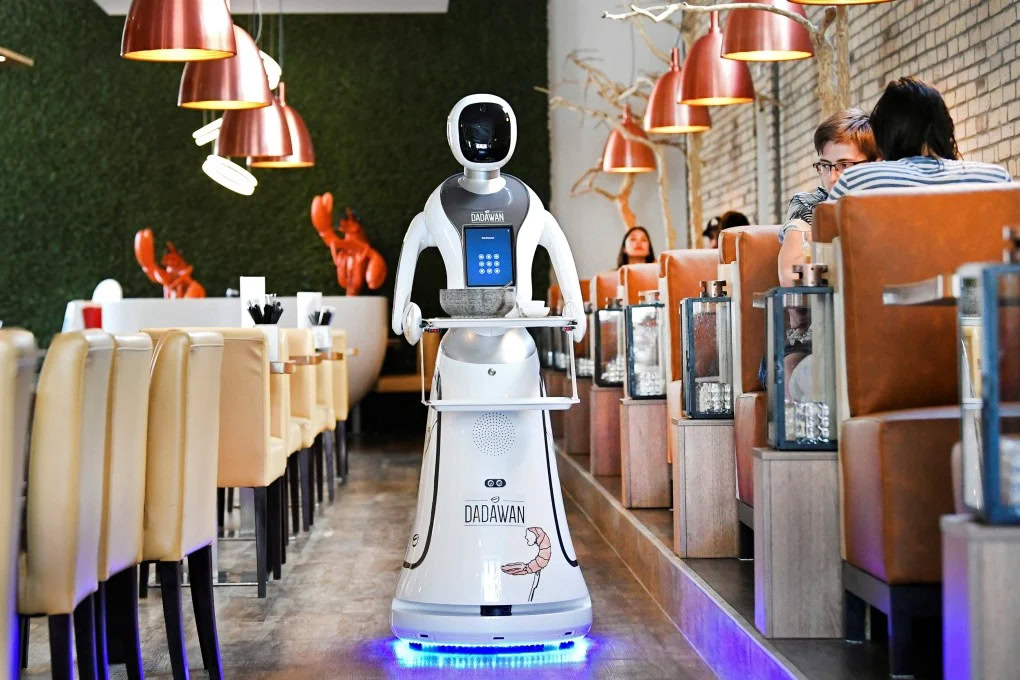
The “Robot” often is made to look semi humanoid and may also have a large LCD screen on it. This is really just for show. The device itself is basically a motorized and automated delivery cart. It is programmed to go to a table it is assigned to. Such systems have been around for some time. The idea of “robot” vehicles to do this has been pushed since the 1980’s. Remarkably little has changed, other than the aesthetics. The idea pops up every few years and we are told technology is finally ready to put waitstaff out of a job. In fact, the automated delivery cart concept goes back until at least the 1950’s, when wire guided vehicles demonstrated the concept.
What is really remarkable is how mature and diverse the methods to replace waitstaff with automation have been. There are a number of novelty restraints, where model railroads deliver food from the kitchen. These are all just for fun and novelty, but similar concepts, of railed vehicles of all types have been floated as replacements for waitstaff. Beyond that, various schemes to motorize or automate the delivery of food to one’s table at a restaurant has a shockingly long history.
Automats are a form of automation that enjoyed some success. These did not try to replace waitstaff, but instead made the whole process a self-service affair.
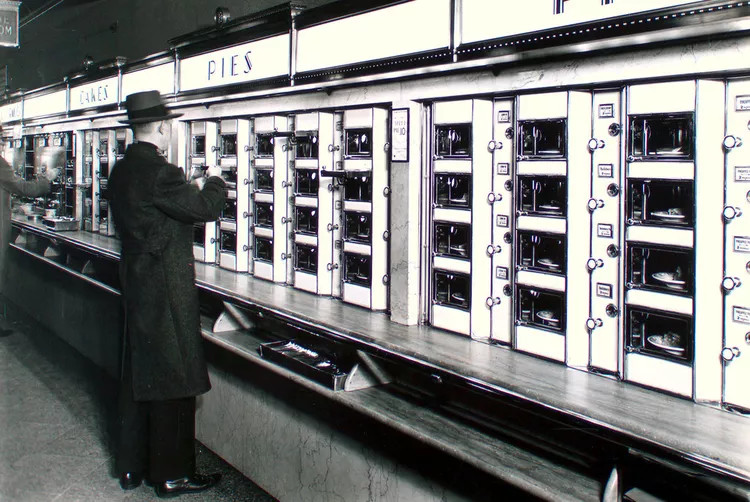
The earliest mechanized delivery systems began in Germany, in the late 1800’s. These “Pushbutton” restaurants were popular and various mechanical delivery systems were demonstrated, primarily as a novelty. By the 20th century, however, there were honest attempts to use mechanized delivery to tables as a more efficient or cheaper way of delivering food. To this extent a huge number of schemes have been tried. Cable ways, electric carts, conveyor systems. Nearly every type of delivery system one could imagine has been tried.
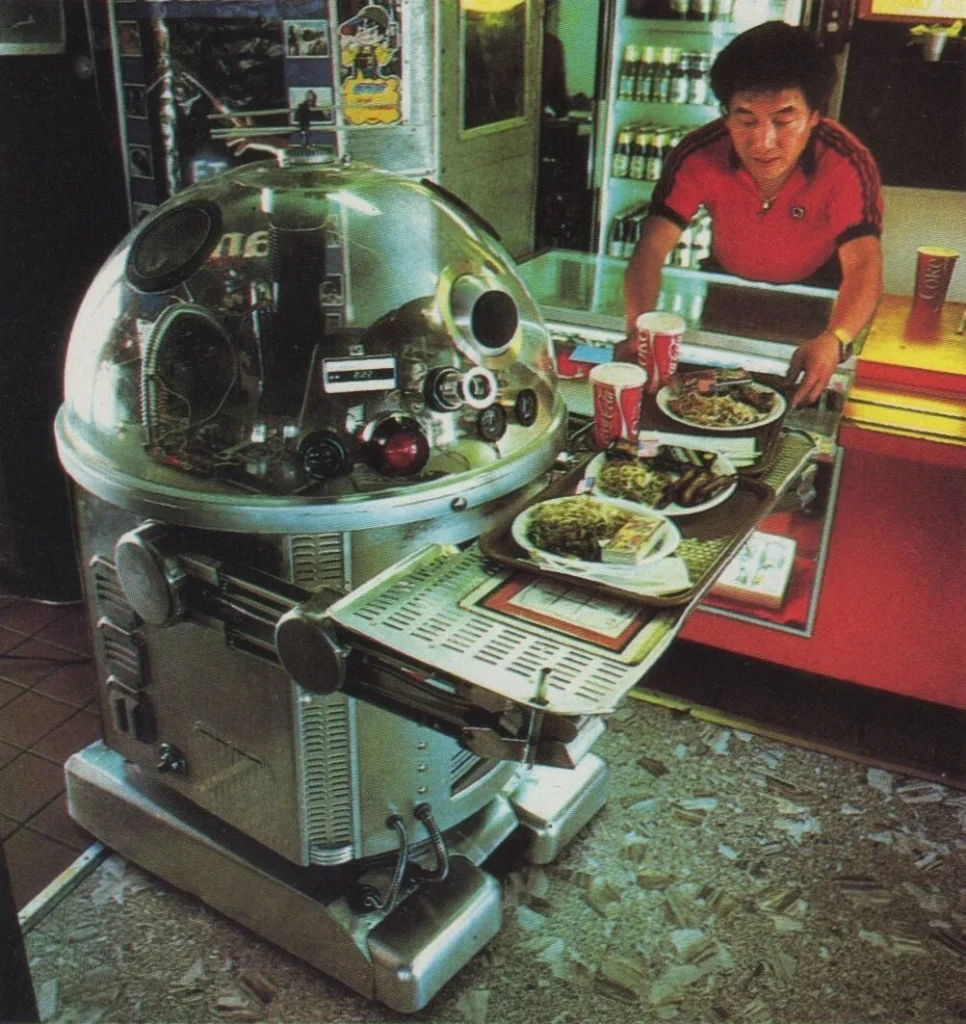
The image bellow is from a revival of the fad in the 1980’s. This “robot” was touted as the replacement for waitstaff in 1983.
Successful concepts that replace waitstaff do so by making the system self-service, as opposed to sit-down service. The automat was a concept that enjoyed a brief period of popularity in the first half of the 20th century. Automats were fully staffed with kitchens and attendants, but food was placed in coin-operated vending machines. Automats were quite famous for having good quality food, despite the fact that vending machines would later be associated with lower end products.
Of course, none of these schemes actually caught on. The closest to any widespread success is the sushi restaurants that use conveyor belts. But that’s a special case and it is partially for the novelty. Despite the fact that many have tried to make robotic waitstaff a viable business model, this has just never worked. Despite being a popular attraction at several World’s Fairs Expositions, robotic restaurants seem to only be able to survive on pure novelty.
One of the most high profile failures was Ken Chen, a highly hyped automated food delivery robot of the 1980s. It as supposed to revolutionize food service. Of course, it didn’t,
Ordering:
Of course, waitstaff don’t just deliver food, they also take orders. In other styles of food service, orders may be taken at a counter by a cashier. This role has also been one that has been subject to attempts to mechanize and automate, with varying levels of success, but in no cases completely replacing staffed customer service.
Early attempts to automate ordering from ones table seem like a natural extension of basic systems of automation. Early on, systems were developed that would allow diners to press a button to indicate the food they want. This could illuminate a light board in the kitchen. Other methods have been trialed, over the years. Voice intercoms, various computerized interfaces and, most recently, phone apps and tablets in place of menus.
In the 1960s, drive-ins experimented with push button food ordering
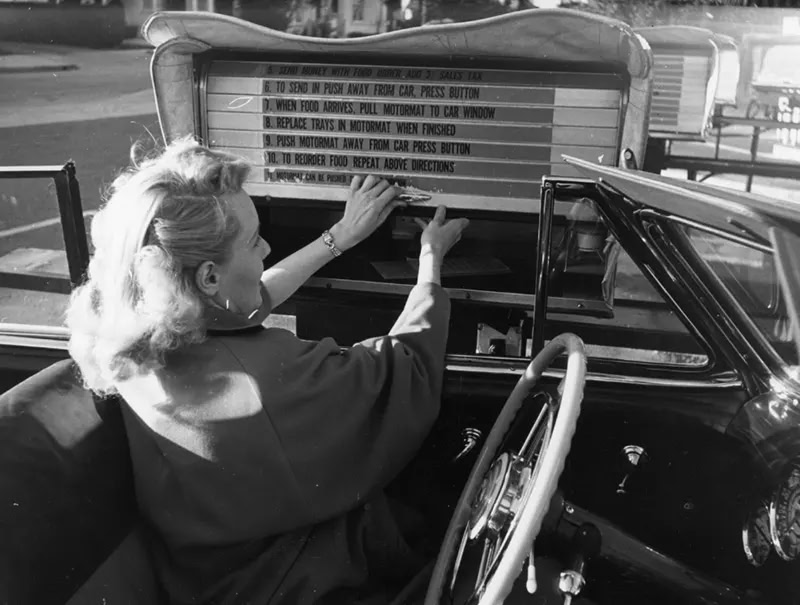
These systems work well enough. They even make sense in some narrow circumstances, but they have never and will never really replace waitstaff, because waitstaff do more than just receive an order for the food. Like other solutions, they are setting out to solve a problem which really does not exist and are capital intensive solutions that lack flexibility and fail in non-graceful ways.
Self-service ordering, in various types, on the other hand, has always been more successful because it’s not simply about replacing staff. For many circumstances, the transaction is just faster, easier and more convenient when it’s self-service grab and go. That’s why things like automats were successful. They didn’t attempt to replace the waited table experience with automation, but instead created a new experience that was perfect for dropping in and grabbing portable food. That’s why similar concepts work so well, even if the classic automat has been replaced with vending machines, self-checkout stores and amazon express.
Then there are ordering kiosks, which have become common at places like McDonalds. They were also touted as being on the verge of replacing counter staff, with dire predictions from the early 2010s claiming that kiosks would be the end of food service cashiers and cost tens of thousands of jobs. Of course, despite ordering kiosks being a mature and fully deployed technology, that’s not what happened.
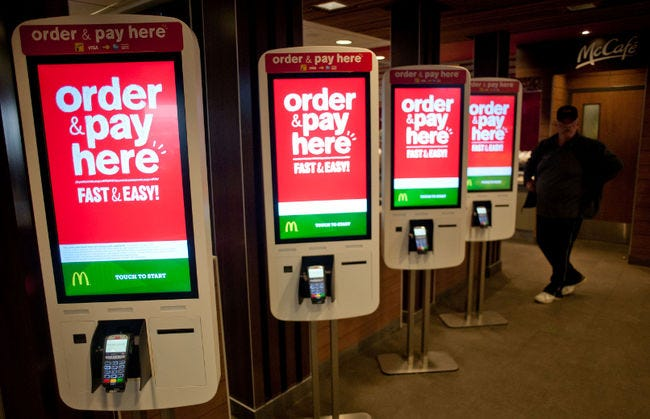
Restaurant kiosks are not a one to one replacement for workers. They offer some great advantages for both customers and owners. Kiosks remove most lines and the social pressure to order quickly. They allow customers to see all their options and customize their choices, adding custom sauce combinations, adjusting options or asking for extra cheese or no lettuce. They also allow for suggested addons, quick simple things like cookies or drink upgrades. This is great for business because all those options the company to upsell on optional. They also lend themselves to being flexible to special promotions, they work well with apps and loyalty clubs and don’t take up much space.
But, surprisingly, they don’t really replace workers. There is still a counter service worker to receive the food from. They still are there for requests and edge cases. Importantly, they are still required for cash transactions and other cases. Counter staff, these days, spend a lot of their time assuring that delivery people get the proper order out the door. They spend their time explaining that the ice cream machine still does not work or taking orders from the customers who still prefer not to use the kiosks, a demographic that still very much exists.
If anything, kiosks have increased the need for fast food staff, but the work looks different today than it used to. Today fast food is more grab and go than ever before. Sit down sales are down and delivery is higher than ever before. More combinations are customized using either kiosks or online ordering. So the job profile has changed a lot, but kiosks did not wipe it out.
Kitchen Staff:
Replacing cooks and other kitchen staff with automation has been a long standing goal of a large number of inventors and companies, with a huge amount of engineering investment going into the problem. Some have even brought entire systems to the market. While many ventures and proposals have come and gone, none have managed to gain widespread adoption. The goal is always the same: to make the business faster, more efficient and easier. For years, it has been stated that staff would soon be replace in mass, but this has never happened.
That said, certain aspects of running commercial kitchens have been automated. At one time, most dishes pots and pans were hand washed, but commercial dish washers do the work at most larger establishments. There is also some level of automation and assistance to stoves and cooking equipment. But overall, cooking in eating establishments has remained a human-staffed position, as it always has.
It’s not hard at all to see why this is the case. The economics of attempting to use robots in this capacity are brutal. Despite the fact that it keeps coming up and new generations of inventors keep trying their hand at it, there are few environments more poorly suited to the use of robotics and mechanization than cooking in a kitchen at a crowded diner at lunch time. The technical operations and economics are both stacked against this working.
First, consider the economics: most restaurant are small ventures. They are the quintessential mom and pop operation and even large chains are often run by franchisees. They are high volatility, high risk ventures. More restaurants go out of business than any other type of company each year. As such, they are operations that struggles with capital expenses. And robots are extremely expensive and are a pay up front cost, which represents a very high risk for a sector so prone to volatility.
The need for high dexterity in cooking has resulted in robotic designs that use complex actuators to achieve human hand like control.
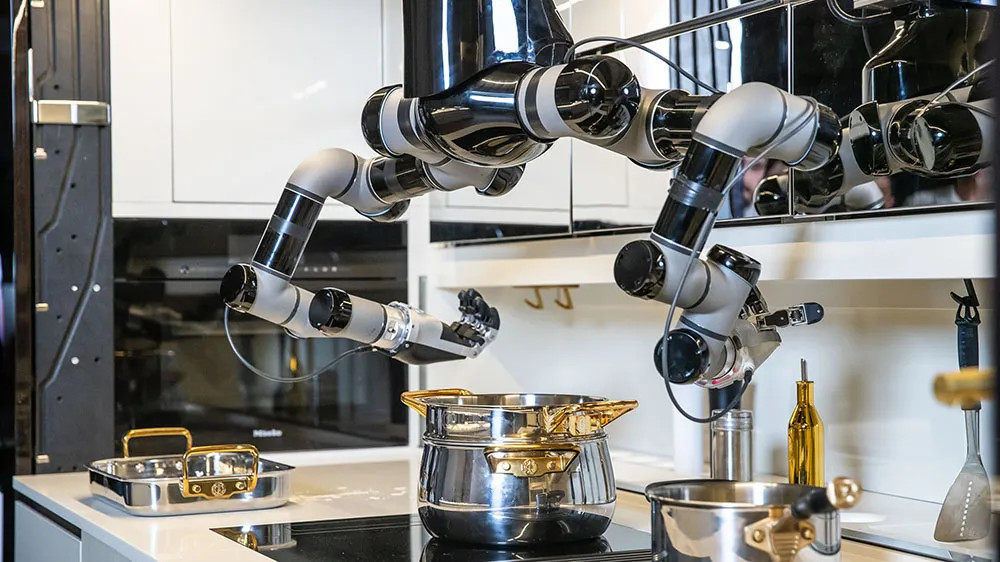
Compare that to hiring a short order cook. Human employment is pay as you go, so it’s much lower risk. There is also inherent flexibility. The owner or someone else can help out if things get especially busy. The arrangement is elastic. It’s possible to hire additional staff or let them go, as demand changes. They are also redundant and scale. A person can substitute for another person if they are out.
Robotics are inferior in every way except for the fact that they are not paid wages. That’s about the only advantage. A kitchen robot may cost a quarter of a million dollars or more. In a complex establishment, with multiple cooking stations and roles, it may be necessary to add more robotics and automation. All of this must be paid of up front (or financed, which only moves the expense) and then must be maintained. Automated systems do require servicing. They may also require insurance.
It’s a huge investment and these systems depreciate quickly, so it’s highly unlikely that cost can be recovered if it does not work out or if the restaurant goes under. This is all the more true because the systems have to operate in the worst environment: grease, food particles, heat, fluids and rapid demands. This is murder on equipment. Ask anyone who works in a kitchen, the grease gets into everything. Robots do not self-heal the way humans do and are not resistant to moisture.
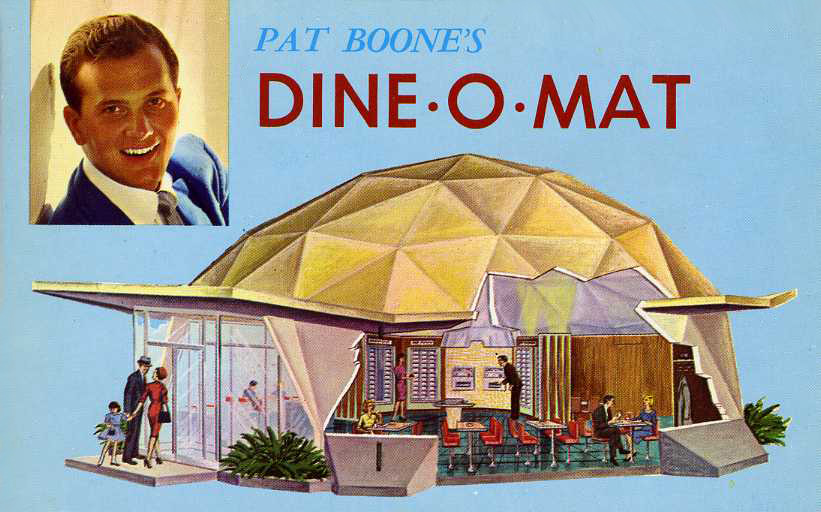
The concept, and desires to have fully non-staffed kitchens was pursued in different ways in decades past. Some inventors attempted to use conveyor belts and assembly stations. Tanks and pumps that automatically dispensed sauces and ingredients have been tried. In the 1960s, Pat Boone funded the Dine-o-Matic, a short lived concept that involved automated heating of premade frozen entrees. Many of the early ideas of a “kitchenless restaurant” were based on the idea of pre-packaged heatable entries. Although it did work, it never was a business success.
Robots are also terrible at adaptation. Food service is all about customizations, questions, allergies, things cooked to special instructions. It’s the rule not the exception. There are also menu changes, specials, improvisation with ingredients run out. These are all things that humans excel at. The system already works well as is. Hiring cooks can be done rapidly. It’s a distributed elastic cost. It’s flexible. It’s low risk. It removes the single point failure of the robot failing and the entire restaurant being paralyzed.
There’s another important truth to this idea: Because of the nature of the business, where systems can go down and special requests abound, where some tasks require a lot of dexterity and things often need to be cleaned, none of these schemes have been able to come close to actually avoiding on site staff. You still may need just as many people to babysit the robots.
At the end of the day, there is one thing that stands out about attempts to fully mechanize restaurant kitchens: There’s really no value added to the consumer and nothing is improved. From the standpoint of the restaurant owner, things are hardly better either. The only thing gained is that there are fewer employees to pay. But the economics, reliability, long term value, risk and adaptability are all much worse.
And that, right there, is why we are not going to see any fully automated restraints. Yes, we will see continued efforts to push it, because there always have been. A great example is the bankruptcy of Zume. The Silicon Valley company raised and burned through over 400 million in venture capital to build robots that could make pizza. The problem: The pizza didn’t appear to be anything better than other pizza. It does not appear that their system actually saved much labor, because people still needed to load the pizza onto a conveyor belt, so the robot could apply topings.
Zume needed to justify their new (and very expensive business plan) so they came up with the idea of pizza that is fresher because a robot loads it onto a special oven, in the truck itself, so it cooks on its way to the delivery address and is fresher. Well, that was the idea. But can anyone tell the difference between five minute old pizza and fifteen minute old pizza? It was an attempt to make their technology relevant to operations. They also tried to pitch it as a lower cost solution, since in theory, you could do most of the cooking in the truck.
The only attempts that have ever managed to even field a prototype for a fully automated food service system have had to limit their offerings to a narrow and special chosen type of food, such as pizza or foods that are relatively easy to cook in pre-packaged and proportioned packages or those which lend themselves to an assembly line like cooking process.
It is one of those ideas that, for whatever reason, gets a new injection of enthusiasm and funding every generation. It’s always touted as obvious and the next big thing to come to automation. Recently reports of “the world’s first fully automated restaurant” have been circulating. In fact, Jays Brookdale restaurant claimed this title in 1966, but even that is in dispute. (No word on what happened to Jay’s or the few others who tried it)
A photo from one of their prototype locations shows how human workers place the pizza dough on a conveyor, so that automated dispensers can put sauce and cheese on it…
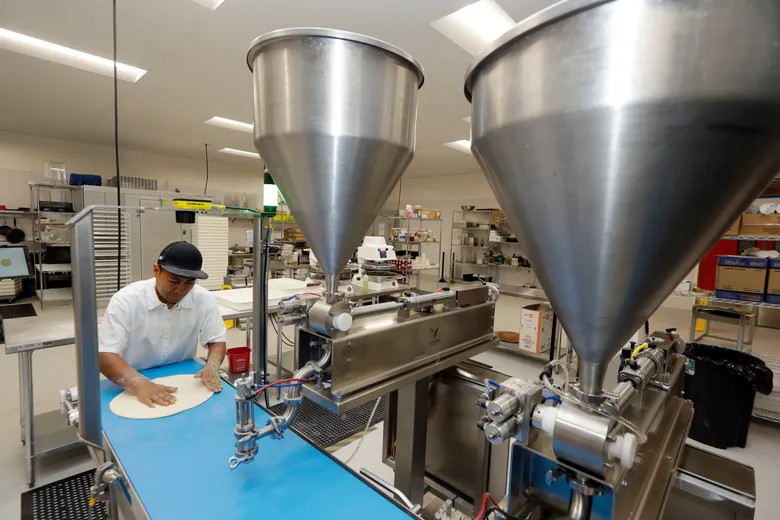
In the end it was an overengineered solution to a non-existent problem. I am sure we will see more in the future. More pitches will come. Hype will build. VC will burn. Rinse and repeat. What will continue to be automated are the things that make sense. Kiosk ordering for some establishments, self-service and common sense automation, like dish washers. But the idea of a fully robotic cafe is going to have to wait for the idea to make practical and economic sense and outcompete the alternative. That is likely never going to happen.
I think what it really comes down to is that, as you say, the economics of hiring people is pretty good as is. And I think the last photo shows how ridiculous it is. The machine has to earn its keep, and that means doing more with less. It’s actually surprising to me that anyone thought that robotic pizza was worth spending so much money to make work, when non robot pizza exits and is fine.
What you have to do is make it better, faster or cheaper or nobody will favor it.