If you happen to visit this site from time to time, you probably will have noticed that I have not been posting many updates. There’s a reason for that: I have been primarily focused on writing my book about AI. It has been a few months, but writing a non-fiction book is extremely difficult. In fact, almost everyone who starts writing a serious non-fiction book later will say that they underestimated how difficult and long it would be. I figured I could handle it, because I’m a good writer. Like everyone else, I underestimated how hard it would be.
The book I am writing has a sense of urgency to it, because as AI is being adopted so widely, we are seeing unprecedented misinformation and mythology being presented in the media and taken seriously by adults, who truly should know better.
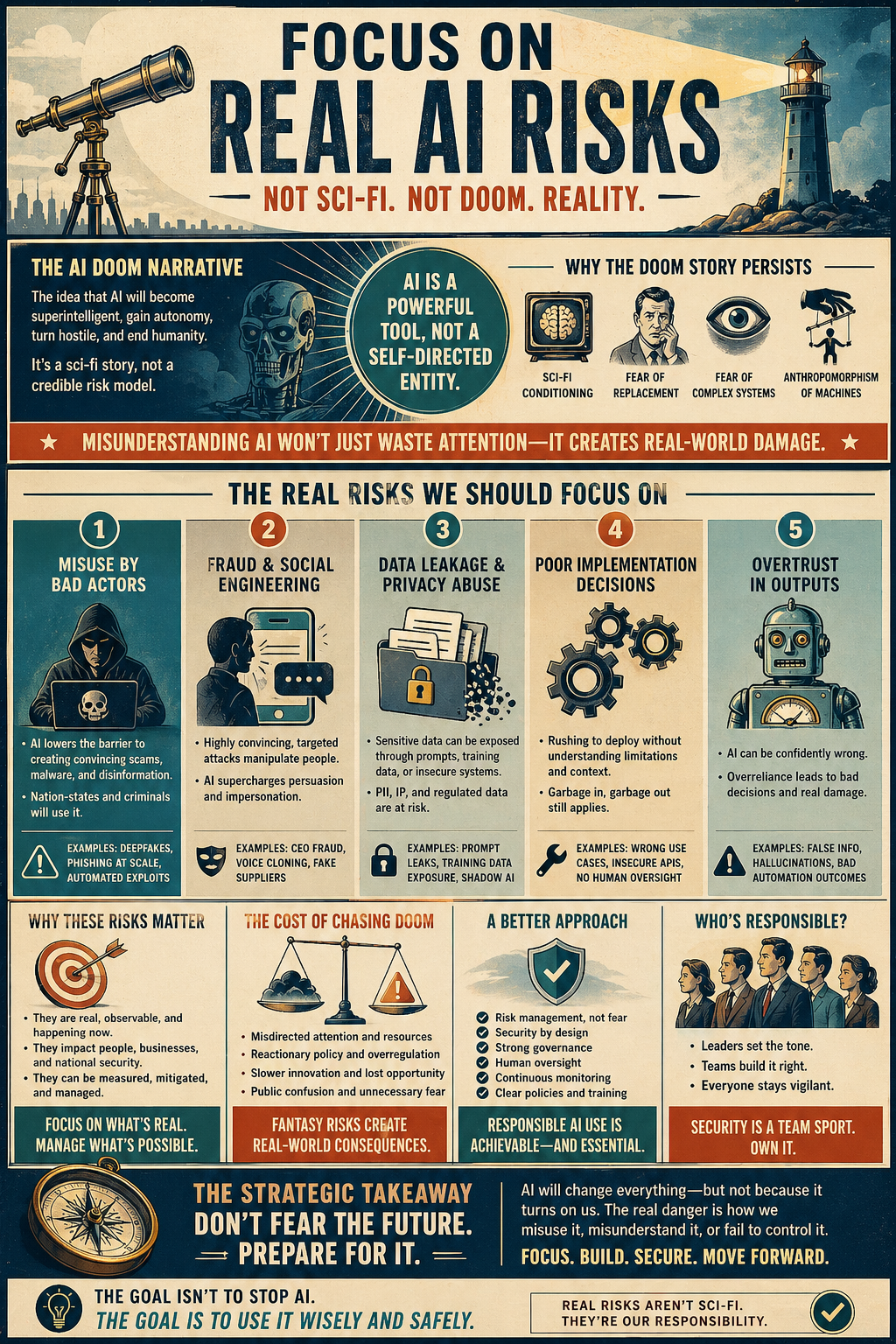
What is far worse is the AI fear movement (AI Doom) which has become one of the most ridiculously unhinged parts of the effort pushing myths and stupidity about AI. Of course, machines do not have desires, do not act on their own accord and are not capable of being gods. Superintelligence is a fictional construct that does not even make sense once you start to ask serious questions about what it means. Intelligence in and of itself is rarely a trump card when someone else has resources or knowledge you do not. LLMs are linear and have inherent limitations.
The idea that machines will gain bad intentions is complete nonsense, and yet we see increasingly unhinged and dangerous rhetoric saying the opposite. Take this Youtube video I came across recently, The braindead nature of AI doom isn’t really what we have to fear. If people truly believe that the human race is in danger, is violence even unreasonable?
Yudkowsky, a junior high dropout who has no background in almost anything, and is one of the most celebrated profits of the cult of doom has made statements about bombing data centers. A splinter group of AI doom has already committed murders. Sam Altman’s house was shot at, and a Molotov cocktail thrown at it. A mentally disturbed AI protestor went missing causing major concerns by police. None of this is surprising at all.
And then I see yet another post, this time on YouTube, celebrating a terrorist who had an unhinged fear of technology driven by literal schizophrenia.

And this is why I am writing the book. It’s an urgent plea for sanity, and an attempt to dispel myths about AI and provide all the supporting evidence so that people can truly understand how AI works and what it is and is not.
AGI (Whatever the hell that is) is a major topic of confusion and misinformation, so I have decided to present my core chapter on AGI. Bear in mind that this chapter does not really stand on its own. By the time a reader gets to this chapter (the 14th) they will have fully learned about: The history of AI, machine learning, deep learning networks, neural network dynamics, how training works, the transformer architecture, vector embeddings, attention mechanisms, catastrophic forgetting, neural compression, scaling laws and alike. If it seems like “This point assumes the audience already knows..” that is likely because it is the 14th chapter.
This is presented as is. It is a draft. It will almost surely be very refined and revised before the book is finalized. Also, keep in mind that, as an early draft, it is likely to have a few typographical or formatting errors, sub-optimal wording and similar. Normally, I might hesitate to make public such a work in progress. However, with the increasing nonsense and dangerous degeneration of understanding about what AI is and how it works, I have decided to try to get as much out as soon as possible.
Continue reading