
Cowards and Criminals: How the Felonious Behavior of Cyber Underwriters Caused the Ransomware Crisis

A chapter from my upcoming book examines cyber security and how AI impacts risks. AI does not substantive change the cyber security equation. It does require that we accept the reality of cyber security.

Every single American is owed one thing by every single publicly traded company: They must conduct themselves in a law abiding manner. No company has the right to engage in criminal activities. Any reasonable examination of ransomware insurance reveals the normalization of felonious activities.

Cyber security is a topic that has come up frequently in the discussion of artificial intelligence. Cyber security, like artificial intelligence, is a very poorly understood subject. It is something that, like AI, has created a great deal of banter from non-experts about doom scenarios.  What makes cyber security different is that the lack of understanding is not related to any inherent complexity or unfamiliarity. Cyber security is one of the most straightforward pursuits. The confusion around it is completely artificial.

The primary way in which AI changes the cyber security threat landscape is that it enables malicious actors to automate attacks in new ways and it removes previous barriers to hacking. Many attackers are located in foreign countries, but AI removes the language barrier. Attackers may need to survey many systems to find a weakness, but AI can do that automatically. Finding bugs in software code is a task that requires expert human review, but AI can find bugs without needing an expert.

AI doesn’t only speed up and automate cyber-attacks. It makes new forms of cyber attack possible.  With AI it’s possible to create more diverse code than could be generated with human programmers. AI allows for exploits to be discovered and taken advantage of in ways that can’t be easily remedied. It can perform the kind of deep analysis that would be impractical with only humans.

One of the most important aspects of modern AI is its ability to process conversational, written and human communications. It does not only interface with technical systems and commands. AI can parse huge amounts of copy, looking for useful information about targets.  It can be used to aid in open-source intelligence. It can also be used in direct social engineering attacks, creating phishing messages and even engaging in two-way communications with end users, completely on its own. It also complicates identity due to deep fakes and voice cloning.

There is another side to this. AI can also be used to enhance cyber security, and there are many AI cyber products on the market. Of course, part of this is branding, but there is an enormous potential to improve cyber security defenses, responses and evaluation.

Some have said that AI is the end of cyber security, as we know it. That may very well be true. That’s not necessarily a bad thing either. Cyber security, as it now exists, is barely economically sustainable.  The levels of economic loss from cyber security incidents are staggering. The problem is that, if cyber security losses increase substantially, they will begin to cross the threshold of being truly economically unsustainable.

Cybercrime already carries an enormous economic cost. Cybersecurity Ventures projected worldwide cybercrime costs of $10.5 trillion in 2025, including stolen money, lost productivity, business disruption, intellectual property theft and the expense of recovering from attacks. The FBI’s Internet Crime Complaint Center received more than one million complaints in 2025, reporting $20.9 billion in losses, an increase of 26 percent over the previous year.1 These reported losses do not capture the full economic damage, including many costs associated with interrupted operations and recovery.

The amount of money lost to cybercrime is staggering. It’s a huge invisible tax we all pay. Cyber-attacks have cost so much, at more than ten trillion a year, that they have become a driving force of inflation. The cost is redistributed in the form of insurance premiums, taxes, interest rates and other economic losses.  That’s why it is not easily visible. Hospitals are under constant cyber-attack, something that would not have been tolerated at one time. The cost to healthcare has been enormous. It is one reason why healthcare inflation is so hard to keep in check.

Cyber-attacks are driven primarily by ransomware.  Ransomware has hit thousands of small businesses.  It has compromised the information of millions of Americans. It has taken out large companies, costing billions, as well as small towns and emergency services. Worst of all, ransomware is constantly being used to attack the American hospital system. In 2024, Change Healthcare, part of United Healthcare was hacked by a ransomware gang and taken offline for more than a month.2  Millions of Americans could not get their prescriptions.  Clinics went unpaid, and financial losses measured in the hundreds of billions.

Cyber security does not just protect companies from losing money. It is also a vital part of national defence. Cyber-attacks can compromise secrets, shut down systems and be used in hybrid attacks against infrastructure. Concerns have been raised over water systems and other vital infrastructure.3

Current losses are almost unsustainable as is. If AI based cyber-attacks raise the losses much higher, then the system may begin to buckle under the losses.

Surprisingly, and contrary to popular belief, it’s not at all inevitable that cyber losses be high. The current situation, with all its trillions in losses, is entirely artificial and could be fixed with policy changes. AI may finally drive the change.

Continue reading →
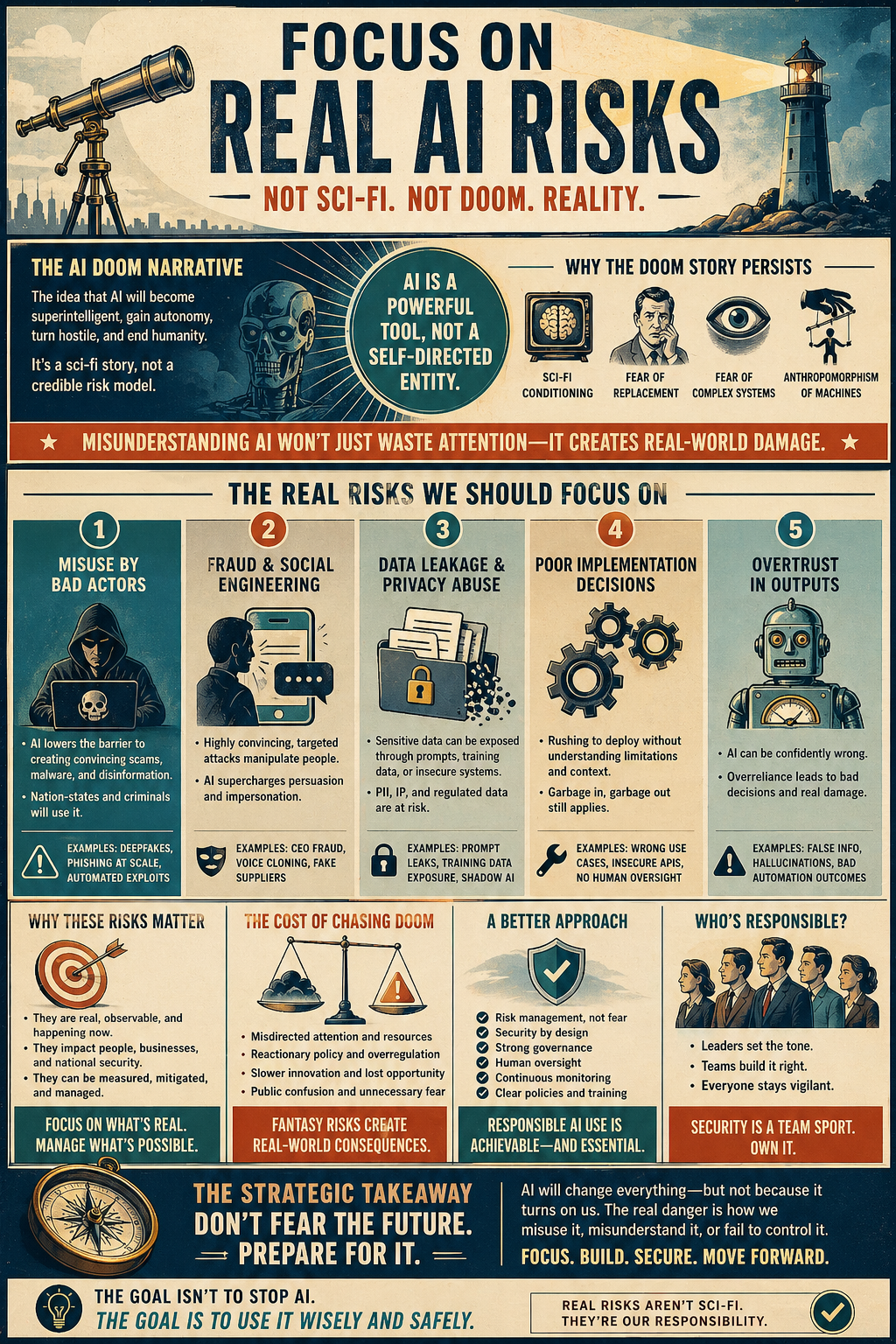
A Full List of Risks of AI to Society

AI is a big thing, a huge force in the economy and basically the top story in tech since 2022. It promises to have major impacts on society and technology, and it already has. With this, of course, come risks. Every new technology or change in a society has ups and downs. This is no different with AI. With new capability comes the potential for misuse or unexpected failure modes.

This has happened many times when technology was deployed, with great enthusiasm and little concern for risks and controls. The problem with AI, unfortunately, is that discussion of AI risk quickly descends into ridiculous philosophical banter, in which people who have no idea how the technology works try to appoint themselves experts and then dominate with riduclous concerns.

The “AI Risk” and “AI Safety” community are dominated by people who bought into the ramblings of doom grifters with books and Ted talks to sell. This is a problem, because there are real risks and risks that should be considered. Rarely do the adults in the room get to have the conversation. AI has no intentions, it is flawed and imperfect, and the idea of superintelligence is flawed. And yet, the real danger is that this will crowd out discussion of the issues that are legitimate risks.

Here is a comprehensive taxonomy of what the risks are to society of the deployment of AI at scale. This does not include the internal risks to organizations of AI failure. Discussing how models fail is another important area, but it’s a different topic.

I am sure that some will disagree about how severe the risks are and if I am downplaying them. For one thing, I started thinking AI would result in mass unemployment, but after looking at the situation and the model capabilities, I was surprised to find that I found that conclusion is not supported by evidence. This is probably the one area people will disagree with the most.

Continue reading →

Preview of Another Book Chapter

I have decided to publish a second rough draft of a book chapter. One of my primary reasons is to get the content out as soon as possible, since my motivation is to help with the extreme misinformation being circulated about AI.

The idiotic “doom” movement continues to operate with seeming credibility despite the childish message that superintelligence will take over the world, like some kind of cartoon villain. Unfortunately, refuting this is hard, because adherents have a completely wrong understanding of how the technology works.

It is clear that to resist this lunacy, along with the equally stupid idea that models might be conscious or have feelings, you simply need to know how this actually works. That’s what “Understanding AI” is all about. That’s why I’m writing the book. It’s a decidedly not dumbed down primer on AI. It explains the theory, early evolution, why things are done as they are, neural networks, deep learning, natural language processing and generative AI.

This unapologetic adult and broad primer will help make anyone immune to the extreme cultish nonsense that has surround the subject. It does not go into depth more than it needs to, but it assures all relevant concepts are covered in a computer way that does not insult the readers intelligence.

This is not the second chapter of the book, but rather the 7th. It is, of course, subject to change, as it is a draft. But, putting it out there, if nothing else, holds my feet to the fire, to get it done. I’m sure it will receive at least three major revisions, but so far I have not seen such a comprehensive account of the dawn of generative AI from anyone inside the industry.

Continue reading →

Restaurant Automation: The Bad Idea That Won’t Die

While researching the wild claims that everyone is going to lose their job forever, because of AI, I came across a claim that struck me as strange. A large number of organizations, which claim to help understand potential job displacement have indicated food service and restaurant automation would soon be coming to take the jobs of cooks, waitstaff and everyone else who works in the sector. In fact, some have predicted that within a year we may lose 80% of jobs in the restaurant sector to robots.

I was pretty stunned. A large number of commentators, for many years, have smugly preached that the waitstaff, cooks, chefs and everyone else who works in the sector were in a terrible position, where their jobs were about to go away for good. Really?

The restaurant sector has been on of the most resistant to automation, and for obvious reasons: it’s a messy, irregular, fast moving business that operates favorably with human labor economics and seems to be purpose built to be hostile to automation. Still, this idea is not new at all.

In fact, restaurants have been the subject of nearly constant efforts to automate processes. There is really nothing at all modern about the idea. Fully automated kitchens and restaurant that deliver food by motorized cart or conveyor have been a staple at Worlds Fairs for decades and other novelty settings. The concept is rehashed every few years and with it comes the predictions of the robotic takeover of food service work. Of course, this never happens.

From the numerous attempts to replace the service staff in restaurants, which many engineers have spent much time on, since at least the 1930s, and the ongoing hype, this presents an interesting case study in an attempt to automate jobs that really have no rational reason to be automated. What is clear here is that there are many roles that technically can be automated, but are far worse off by automating and have little to no economic incentive to do so. It’s an important lesson to keep in mind with the “AI will take everyone’s job” rhetoric that has been making the rounds.

Here is a video on the topic from 1966

Continue reading →

First Draft of First Chapter of My Book “Understanding AI”

So I have decided to write a book. Crazy, perhaps. It is something I have wanted to do for years and faced many false starts. I think a lot of people have been through that. It’s not easy, but I knew that. It’s actually harder than you’d ever imagine, at least for me, but then again, this is the first time I have truly committed to the pursuit.

The reason I choose to write this is that AI is the most poorly understood topic I have ever seen, and has been wrapped in mythology. This is especially true with “AI Doom.” The problem with these beliefs is that they are difficult to refute without teaching a full lesson on AI. So, I guess that’s what I’m going to have to do! I’m not complaining, however. The fact is, there is really no in-depth guide for smart people who want to truly understand the concept of artificial intelligence.

I want to be clear that this is a first draft of the first chapter. It will be revised, probably several times. It currently lacks citations, but those will be added. Citations will be minimal because this is not a scholarly work, but should still have basic source credibility. Additionally, this chapter contains assertions which some might call bold or unsupported. There’s a reason for that and the reason is that this is just the first chapter.

Subsequent chapters will explore the history of AI as a concept and technology, including the pre-history and how formal logic rules, early computers and language itself set the stage for a new form of data processing, which we call artificial intelligence. It goes on to explain the theory of deep learning and neural networks, why this approach won out, and will take readers all the way to understanding natural language processing.

It’s not designed to be easy or dumbed down. However, it is intended to be fully complete for any lay person to fully understand why AI is the way it is, how we got her and where it is likely to go next. It is also not entirely technical. It features historic concept, public perception, regulatory issues and economic realities.

I also want to add that there are a number of people out there who are writing hot takes on AI that are completely uninformed, and this is intended to be the opposite of that. It’s down to earth, skeptical and presents the truth about artificial intelligence.

The working title is “Understanding AI.”


AND HERE IT IS!

Continue reading →

Should Chatbots Refuse to Give High Risk Advice?

Chatbots are becoming increasingly popular. ChatGPT, for example, has nearly a billion weekly users. These LLM based services are used for all kinds of things, including many things their initial developers never dreamed of: planning, brainstorming, writing, translation, companionship, functional play, humor, studying, reformatting text, creating code. People also ask chatbots for all kinds of advice and facts. Chatbots have become the goto answer engines for questions ranging from “What is the capital of Chad?” to “How long should I boil a lobster for?”

However, there is a problem with LLMs and that is that they “hallucinate.” The term hallucination is a bit of a misnomer, because what is actually happening has less to do with figments of the imagination and more to do with patterns and probabilities. What actually happens is that the LLM confabulates a response that fits the patterns of a valid response but is not factually accurate. This often happens due to the model lacking information on a topic, but it can happen even when the model does have the knowledge in its training data.

No, it is not this kind of hallucination…

Hallucinations are impossible to completely eliminate from large language models. They are as much a feature as a bug, because the ability to create false information is inseparable from the model’s ability to generate fiction and hypotheticals or engage in role playing. It’s the nature of LLMs as stochastic probability engines. The only real way to eliminate hallucinations is to have some sort of output pipeline that involves checking and verification of outputs. That’s not something that chatbots currently do.

This is well understood and documented, but that does not change the fact that hallucinations continue to slip past people and be believed. A number of high profile events have included false citations in scientific journals, fake caselaw presented in court and medical advice for diseases that don’t even exist. One of the problems here is that people tend to believe the results a computer gives them, because in the past computers have been reliable and deterministic.

Continue reading →

Anthropic and the Pentagon Situation

It was just last week that I posted a brief write-up about the situation with Anthropic and the Department of Defense. At the time, it seemed like the worst thing that might happen to Anthropic was a loss of military contracts, but things have escalated. The Pentagon and the Trump administration have ordered the discontinuation of Anthropic products by government agencies and contractors.

This is highly unusual and an extremely aggressive move. Anthropic has received a groundswell of public support, and OpenAI has been getting a lot of criticism for stepping in and signing a major contract as soon as Anthropic was excluded.

The Morally Bankruptcy of Social Media Influencers

This rant is a bit off topic, but I am really taken by how badly social media influencers have inserted themselves into the tragic disappearance of Nancy Guthrie, Savanah Guthrie’s mother. We don’t know what happened to Nancy and 31 days on, things do not look good. No communications has been verified as coming from the perpetrators and the investigation seems to have little direction.

While I do not know Savannah, I’ve met her several times and she’s always been an extremely kind person, but beyond that, this isn’t just a celebrity story: it’s a tragic story of a family trying to find their mother, who was taken, apparently by malicious persons meaning harm. it’s a nightmare.

But for those who want to appoint themselves web sleuths? For social media influencers? For those who want to be thought of as an expert and have a YouTube channel/blog post/podcast to sell? There’s no limit to the baseless speculation and repeated attacks on the Guthrie family, especially her son in law and persons who are only guilty of being part of his life. These egotistical self-promoting vultures do not seem to see any harm in what they are doing.


Do not upvote, subscribe or even engage with these idiotic and useless videos. That’s what gives them an audience and promotes them via YouTube and social media algorithms.

We Need To Take AI Doomerism Seriously

No, not the actual belief. The idea that AI will become a cartoon supervillain and wipe out humanity is as idiotic as it sounds. The danger is that the belief is getting credibility, is taken seriously and is a dangerous red hearing. The grifter economy of AI doom is a self-serving scam, but the consequences are real.

I personally find AI Doom to be more than a nuisance. Most do not realize this but, when you peel away the curtain, the movement is actually based on a strong cult-like belief and has spawned some extremely disturbing rhetoric. There have been threats against AI labs and ridiculous proposals for legislation to pause or stop AI research. There are all kinds of ridiculous claims being made and they are getting media attention> Almost nobody seems to be aware of the true nature of this ridiculous idea.

Most AI experts have disengaged from the nonsense of AI doom. After all, it’s not like it’s interesting and nobody wants to have to deal with their area of expertise being stepped on by people who don’t know what they’re talking about. However, this is dangerous. Doom movements have grown around other technologies: nano technology, vaccines, genetic engineering, nuclear energy and others. What we know is that these movements, unhinged and unsupported though they may be, do not go away and frequently lead to bad legislation and major problems for industries that do not fight back.

AI doom is an especially prevalent threat and it’s receiving mainstream legitimacy and attention, which should be seen as a major problem in and of itself.

What is AI Doom

AI Doom is the basic idea that there is some kind of unique and existential threat to humanity, based on the idea that AI systems and ML models might become “super intelligent” and therefore impossible to stop from causing harm. This is also predicated on the idea that in addition to intelligence being a scaler, which can be arrived at through increased compute, that the resulting intelligence would somehow achieve autonomy and become either hostile to humans or desire to eliminate humans to gain more resources.

It’s not an entirely new idea. It’s been a trope in science fiction for some time. It is based on a lot of universal fears, like not understanding technology, being replaced, dehumanization and the fact that people have been so conditioned by science fiction to expect such an outcome to be reasonable.

Doom literally refers to an “end of the world” scenario, but there are other doom adjacent beliefs and claims, such as the idea that AI will lead to a permanent dystopian society where employment is impossible and power is consolidated or that AI may enslave humanity.

Importantly, while there are absolutely risks of a variety of types that are associated with AI adoption, the idea of a species-level risk from the technology gaining self-motivation and setting its own goals is not plausible at all.

Continue reading →

Anthropic Faces Challenges From Pentagon Requirements

I have been critical of Anthropic before. The company rose quickly and is run primarily by founders who do not come from a conventional business leadership background. The company is governed with a strong spirit of ethics and stewardship.

While I have found their message to be a bit unprofessional, speculative and over the top at times, there’s no doubt that it’s honorable for a company to put its own ethics above lucrative business deals. As so many large corporations support ICE actions and government overreach, it’s nice to see a company that still is willing to stand up and do the right thing.

When it comes to using technology by militaries, the ethics get dicey fast. Is it okay to use technology for purely defensive roles? What if it is offensive, but in a justified conflict? Is it okay if it results in more deaths on the other side? What if a weapon is powerful but its impacts are based on how it is used? Should our commanders be trusted to use technology ethnically? Is it patriotic to provide tech to the military, because it may save out servivcepeople?

These are not easy questions, and companies grapple with them all the time. Some companies are card carrying defense contractors, and that’s just what they do. But war is an unusual situation: The aim is to kill people and cause maximum destruction. That’s at odds with most corporate ethics.

Continue reading →