
A Full List of Risks of AI to Society

AI is a big thing, a huge force in the economy and basically the top story in tech since 2022. It promises to have major impacts on society and technology, and it already has. With this, of course, come risks. Every new technology or change in a society has ups and downs. This is no different with AI. With new capability comes the potential for misuse or unexpected failure modes.

This has happened many times when technology was deployed, with great enthusiasm and little concern for risks and controls. The problem with AI, unfortunately, is that discussion of AI risk quickly descends into ridiculous philosophical banter, in which people who have no idea how the technology works try to appoint themselves experts and then dominate with riduclous concerns.

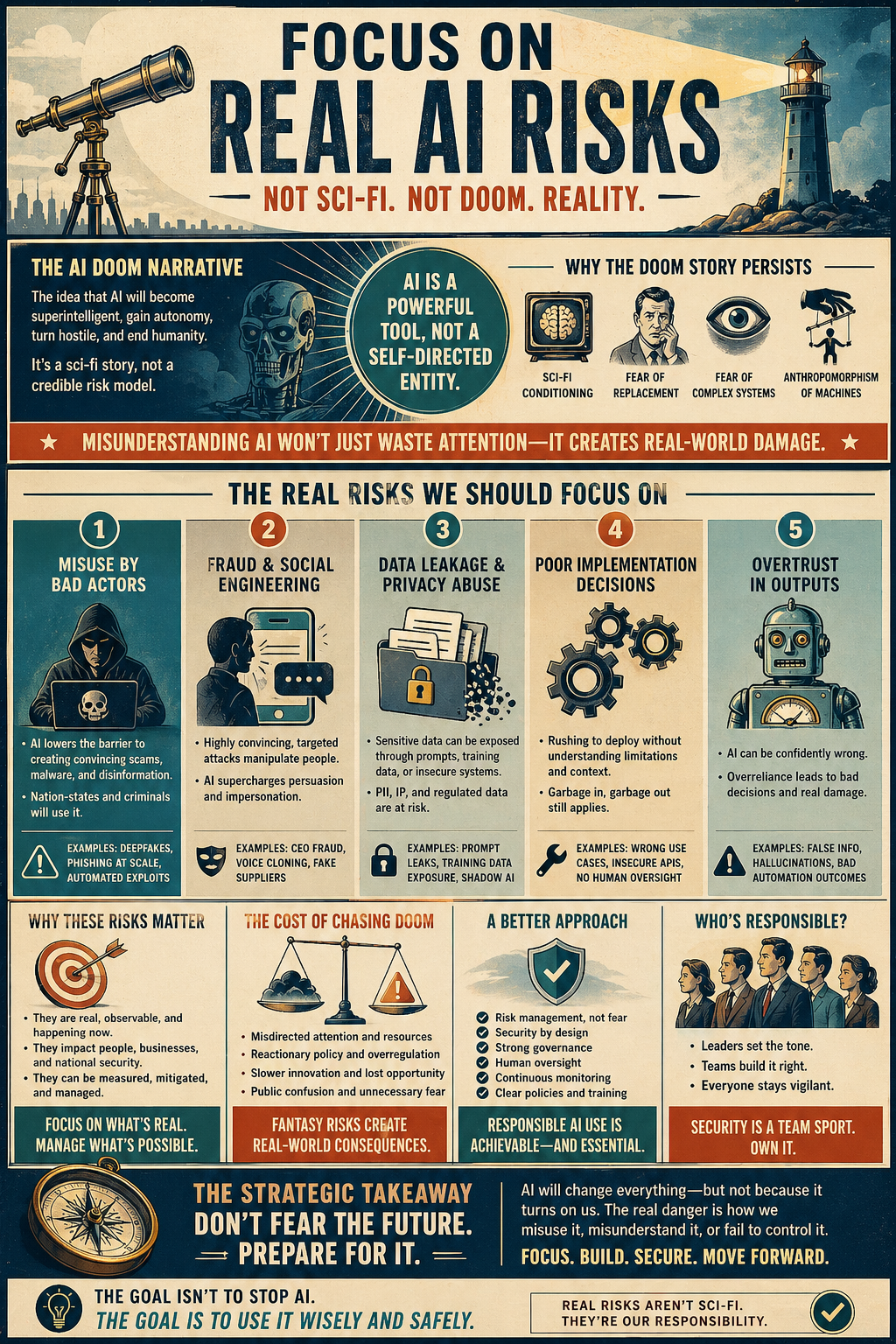
The “AI Risk” and “AI Safety” community are dominated by people who bought into the ramblings of doom grifters with books and Ted talks to sell. This is a problem, because there are real risks and risks that should be considered. Rarely do the adults in the room get to have the conversation. AI has no intentions, it is flawed and imperfect, and the idea of superintelligence is flawed. And yet, the real danger is that this will crowd out discussion of the issues that are legitimate risks.

Here is a comprehensive taxonomy of what the risks are to society of the deployment of AI at scale. This does not include the internal risks to organizations of AI failure. Discussing how models fail is another important area, but it’s a different topic.

I am sure that some will disagree about how severe the risks are and if I am downplaying them. For one thing, I started thinking AI would result in mass unemployment, but after looking at the situation and the model capabilities, I was surprised to find that I found that conclusion is not supported by evidence. This is probably the one area people will disagree with the most.
Continue reading

Preview of Another Book Chapter

I have decided to publish a second rough draft of a book chapter. One of my primary reasons is to get the content out as soon as possible, since my motivation is to help with the extreme misinformation being circulated about AI.

The idiotic “doom” movement continues to operate with seeming credibility despite the childish message that superintelligence will take over the world, like some kind of cartoon villain. Unfortunately, refuting this is hard, because adherents have a completely wrong understanding of how the technology works.

It is clear that to resist this lunacy, along with the equally stupid idea that models might be conscious or have feelings, you simply need to know how this actually works. That’s what “Understanding AI” is all about. That’s why I’m writing the book. It’s a decidedly not dumbed down primer on AI. It explains the theory, early evolution, why things are done as they are, neural networks, deep learning, natural language processing and generative AI.

This unapologetic adult and broad primer will help make anyone immune to the extreme cultish nonsense that has surround the subject. It does not go into depth more than it needs to, but it assures all relevant concepts are covered in a computer way that does not insult the readers intelligence.

This is not the second chapter of the book, but rather the 7th. It is, of course, subject to change, as it is a draft. But, putting it out there, if nothing else, holds my feet to the fire, to get it done. I’m sure it will receive at least three major revisions, but so far I have not seen such a comprehensive account of the dawn of generative AI from anyone inside the industry.

Continue reading

AGI: Cutting Through The Confusion

AGI, ASI and the extreme confusion of it all

There has recently been a huge amount of confusion over the concept of Artificial General Intelligence, AGI, and exactly what it means, whether it is something that should be expected, and what it means for society.  One thing that is seen frequently is speculation of the “Race to AGI” or questions like “How will we know when we have AGI” or “What if they already have AGI and haven’t told anyone?”

This whole line of reasoning, the way it is framed, and the questions being asked here indicate complete incoherence about what AGI or Artificial General Intelligence is, or at least what it is supposed to be. If that is not bad enough we now are being told that AI is close to “super intelligence” or “ASI.” This is an entirely fictional idea, and nobody can even agree as to what it is, other than it might be scary.

The Basic Idea of AGI

The concept of artificial intelligence in the form of a fictionalized “thinking machine” goes back centuries.  The modern concept of computer systems that simulate intelligent behavior dates to the 1950’s.  As systems dubbed AI were developed, it was clear that they were relatively narrow and bounded in what they could do.  Machine learning and cognitive simulations could optimize systems and respond to variables, but they lacked the kind of “intelligence” that we think of in a human.

Intuitively, it was always clear that there existed a higher level of “general intelligence” of the type found in humans and other thinking beings.  In the simplest sense, an AI that could be communicated with, like a person and could understand human-like concepts, like situations being subjectively better or worse.  It made perfect sense that the mental model for what general intelligence would look like would be a synthetic human mind.

The terms for Artificial General Intelligence versus Narrow Artificial Intelligence was coined in 2007, but the basic concept goes back much further.  It had been often called “strong AI,” “human-like AI,” “full AI,” or “true AI.”   In fact, this distinction became obvious early in the field of AI, when it was clear that systems that could mimic certain aspects of human intelligence were distinct from the popular nation of a fully digital mind, or anything like human level capabilities across domains.

Continue reading

Restaurant Automation: The Bad Idea That Won’t Die

While researching the wild claims that everyone is going to lose their job forever, because of AI, I came across a claim that struck me as strange. A large number of organizations, which claim to help understand potential job displacement have indicated food service and restaurant automation would soon be coming to take the jobs of cooks, waitstaff and everyone else who works in the sector. In fact, some have predicted that within a year we may lose 80% of jobs in the restaurant sector to robots.

I was pretty stunned. A large number of commentators, for many years, have smugly preached that the waitstaff, cooks, chefs and everyone else who works in the sector were in a terrible position, where their jobs were about to go away for good. Really?

The restaurant sector has been on of the most resistant to automation, and for obvious reasons: it’s a messy, irregular, fast moving business that operates favorably with human labor economics and seems to be purpose built to be hostile to automation. Still, this idea is not new at all.

In fact, restaurants have been the subject of nearly constant efforts to automate processes. There is really nothing at all modern about the idea. Fully automated kitchens and restaurant that deliver food by motorized cart or conveyor have been a staple at Worlds Fairs for decades and other novelty settings. The concept is rehashed every few years and with it comes the predictions of the robotic takeover of food service work. Of course, this never happens.

From the numerous attempts to replace the service staff in restaurants, which many engineers have spent much time on, since at least the 1930s, and the ongoing hype, this presents an interesting case study in an attempt to automate jobs that really have no rational reason to be automated. What is clear here is that there are many roles that technically can be automated, but are far worse off by automating and have little to no economic incentive to do so. It’s an important lesson to keep in mind with the “AI will take everyone’s job” rhetoric that has been making the rounds.

Here is a video on the topic from 1966

Continue reading