
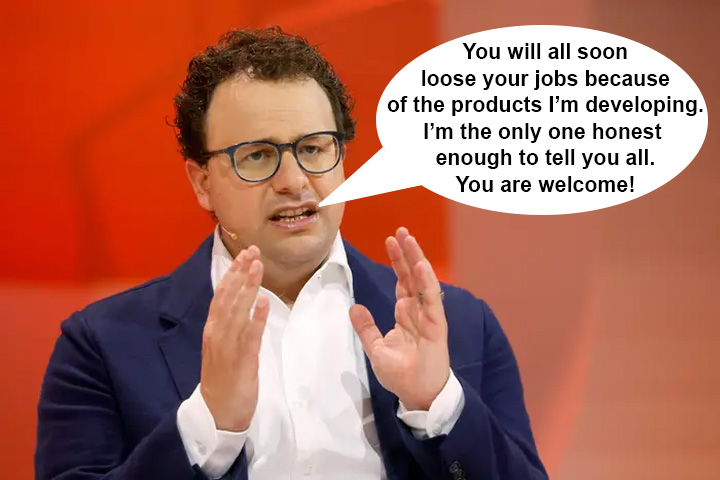
We are seeing an increased public narrative about the potential for job losses from AI deployment. These claims receive a great deal of media attention and are rewarded in the social media landscape for being as pessimistic as possible. Mass job loss remains highly speculative and many claims skew to the highly implausible. But this is causing mass harm.
The increasingly popular narrative of inevitable, catastrophic, long-term job loss due to artificial intelligence is not grounded in robust empirical evidence. It is overwhelmingly speculative, framed in worst-case abstractions, and presented to the public with a level of certainty that far exceeds what the data justifies. That alone would be intellectually questionable. But the deeper issue is ethical: the psychological and social harm caused by repeatedly presenting extreme scenarios as near-certainties.
There is a very real human cost to this discourse. People are not reading these forecasts as academic hypotheticals. They are internalizing them as personal futures. Students reconsider career paths. Mid-career professionals experience anxiety and loss of motivation. Workers in already uncertain labor markets feel prematurely obsolete. This is not a trivial side effect. It is a measurable psychological burden placed on millions of people based on projections that remain deeply uncertain and, in many cases, methodologically weak.
Serious economic forecasting requires discipline, historical grounding, and humility about technological diffusion. What we are instead seeing in many public conversations is a pattern of extrapolation from capability demos directly to labor market collapse, skipping entirely over the realities of workflow integration, governance constraints, liability frameworks, organizational inertia, and economic adaptation. That is not analysis. That is narrative acceleration.
The empirical reality is far more restrained. Despite rapid advances in AI capability, most organizations are still struggling to extract consistent, measurable value from deployment. Integration into real workflows remains difficult. Reliability limitations, oversight requirements, and liability exposure significantly constrain unattended automation. In practice, automation is not replacing entire professions; it is augmenting discrete tasks, often inconsistently.
Moreover, white-collar work is widely misunderstood in automation discourse. These roles are not merely collections of tasks. They involve accountability, ownership, judgment under uncertainty, regulatory compliance, interpersonal negotiation, and risk transfer. Machines can assist with task execution. They cannot assume legal responsibility, professional liability, or institutional accountability. That structural fact alone places a ceiling on full occupational displacement.
Economic history also strongly contradicts the assumption of mass, permanent unemployment driven by productivity technologies. Mechanization, computing, and software automation all dramatically increased productivity. None resulted in long-term systemic unemployment. Instead, labor markets restructured, new roles emerged, and human labor re-specialized around areas where judgment, oversight, and adaptive reasoning remained essential.
There is also a paradox that is routinely ignored: the more powerful automation systems become, the greater the need for human oversight. Advanced systems introduce new categories of risk, verification requirements, governance frameworks, auditing layers, and exception management. Complexity does not eliminate human roles. It often multiplies them in different forms.
This is not to say disruption will not occur. Sectoral perturbations are likely. Certain routine tasks will be automated. Entry-level roles may evolve. Skill expectations will shift. These are legitimate transitional concerns and should be discussed seriously. But transitional disruption is not synonymous with civilizational labor collapse, and conflating the two is analytically irresponsible.
Equally important is the current state of AI adoption itself. A significant percentage of AI initiatives fail to produce meaningful business value. Many firms are still in experimental phases, uncertain how to integrate these systems into existing workflows. We are nowhere near a state of fully autonomous, unattended enterprise automation. The workflow integration layer remains immature, and reliability limitations, hallucination risks, and governance concerns are unresolved engineering challenges, not solved problems.
From a theoretical standpoint, the idea of long-term mass unemployment also conflicts with fundamental economic principles. Human labor consistently retains unique economic value, particularly in areas involving trust, accountability, creativity, social coordination, and adaptive decision-making. Increased automation historically shifts labor demand rather than eliminating it outright.
What makes the current discourse especially troubling is not cautious concern, but the confident promotion of extreme, worst-case scenarios as if they are the most probable outcomes. That framing is not neutral. It amplifies fear, distorts public perception, and undermines long-term career confidence at a societal scale.
A responsible intellectual stance must acknowledge uncertainty. It must distinguish between plausible disruption and speculative collapse. It must weigh empirical adoption data, historical precedent, and institutional constraints rather than extrapolating from raw technological capability alone.
To be direct: the notion of inevitable, long-term mass unemployment driven by AI is, at present, a highly speculative worst-case scenario. It is not supported by historical economic patterns, current adoption realities, or structural labor dynamics. Presenting it as an impending certainty is not only analytically unsound, but socially irresponsible. It risks causing widespread psychological harm, career paralysis, and unnecessary disenfranchisement based on projections that remain deeply uncertain and, in many respects, implausible.